


Cnut (Cnut the Great, King Cnut, Canute, Knut)
King of England, of Denmark, and of Norway
(d.1035)
There is no contemporaneous description or portrait of Cnut, but in the Thirteenth Century Icelandic Knýtlinga Saga (The Saga of Cnut’s Descendants), written just over one hundred years after Cnut’s death, it states:
Knutr was exceptionally tall and strong, and the handsomest of men, all except for his nose, which was thin, high set, and rather hooked. He had a fair complexion none the less, and a fine, thick head of hair. His eyes were better than those of other men, both the more handsome and the keener of their sight.
I have always been fascinated by the fable of the King trying – and failing – to order the sea to go out. Usually cited as an example of the delusory and corrupting nature of power, I have viewed it for a long time as a very clever way to illustrate the limitation of temporal power as exercised by human beings, even kings. If a version of the apocryphal event did take place, it could have been Cnut’s aim to show his people that they should not attribute omnipotence to him, even as their king, but only to God. In today’s world, it could be seen as a very visual demonstration that the human race, regardless of its perceived power, is no match for that of nature.
From the description in the Knýtlinga Saga, I form a picture of a man with a very commanding physical presence. Almost a caricature of a Scandinavian warrior, I think of the eponymous Marvel and film character, Thor, as played by Chris Hemsworth; or Matt Smith as Daemon Targaryen in House of the Dragon, the Games of Thrones prequel (neither of which I have ever watched, only knowing of the character from photographs of Smith in character). In either case, I imagine not a few knees weakening and hearts fluttering (of men as well as women) in the presence of such an impressive blond bombshell.
The description exudes power and probably some (just forgivable) arrogance. The colour of the hair isn’t stated but it has to be fair. I see an angular face and high cheekbones too, suggesting that he grasps his opportunities and is ruthless if necessary. If he does have a less than becoming nose, the eyes quickly distract. In my mind, they are a penetrating and arctic blue. Their 20/20 vision also symbolizes an insightfulness and shrewdness which will serve the king well. They do not necessarily suggest high intelligence but at least the wisdom to know his limitations. Like trying to control the sea. It is no surprise whatsoever that such a godlike human being would die with three kingdoms under his spell.
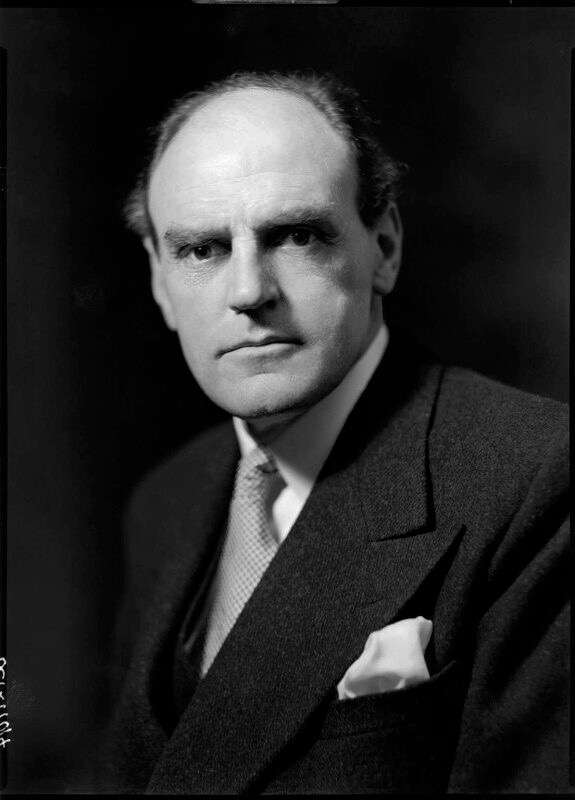
Reith, John Charles Walsham, first Baron Reith
First Director General of the BBC
(1889–1971)
By all accounts, John Reith was probably as fearless as Cnut, although possibly not as wise. Reith was almost certainly more arrogant and self-obsessed. There are stories of Reith clashing swords with other people throughout his life. As a commissioned officer in the 5th Scottish Rifles in 1914, he became known as ‘The officer with the Scotch hat and big spurs’. At six foot six inches, his height – on a par, one imagines, with King Cnut’s – he was already an imposing and rather frightening figure without the hat and spurs.
As far as we are aware, King Cnut never sustained any injury in battle – at least nothing anyone felt worthy of being recorded. Unlike the pragmatic king, Reith took risks on the battlefields, even to the extent of urinating in no-man’s land to avoid the bother of finding the latrines. In 1915, barely a year into the war, his bravado cost him dear, however. Wearing a highly conspicuous new uniform as a result of a recent transfer to the Royal Engineers, he accompanied his major on an inspection of the trenches. If he hoped the new uniform would impress his superior, he should have paid more attention to his heightened visibility to an enemy sniper. Examining a mine crater, a bullet hit his left cheek, shattering the bone beneath his eye and leaving a wound measuring five by three inches, and blood on his new uniform (‘I’m very angry and I’ve spoilt my new tunic’, he is reported to have said from his stretcher). Whatever his feelings on the matter, Reith’s war had come to an abrupt and premature end which left him bitterly disappointed.
Reith’s scar would be visible for the rest of his life, as illustrated by Howard Coster’s photograph. The pain and anxiety it caused him for many years (diagnosed as neurasthenia) only added to his difficulties with personal and professional relationships. Coster’s portrait seems to capture the extent of that pain in the intensity of the staring eyes.
Reith’s eyes also seem to scream out a deep personal frustration with himself. Despite taking many positions of leadership throughout his life, including as founding Director General of the BBC, Reith never seems to have been satisfied in his achievements. While he displayed a confidence, arrogance even, in his abilities that King Cnut might also have felt, Reith never seems to have found fulfilment in his varied and high-powered career.
In 1938, Neville Chamberlain asked Reith to step down as BBC Director General in order to take on the leadership of Imperial Airways. He later berated himself for what he called his ‘monstrous pusillanimity’, his weakness and lack of courage, in acceding to the Prime Minister’s request. His departure from the BBC was traumatic and something which he never got over despite another thirty years’ service in various leadership roles. Would he have even found satisfaction if he knew that his name and the values he established at the BBC would still be cited, in its defence and its acclamation, in pretty much equal measure, long after his death?
It is easy to imagine King Knut relishing his seashore demonstration of the limitation of his own power. It is just as easy to imagine Lord Reith standing at the water’s edge screaming hysterically at the waves as they washed over his shoes.
 Robert James-Robbins
One response to “Turning Back the Tide”
Loving these vignettes.
LikeLike