
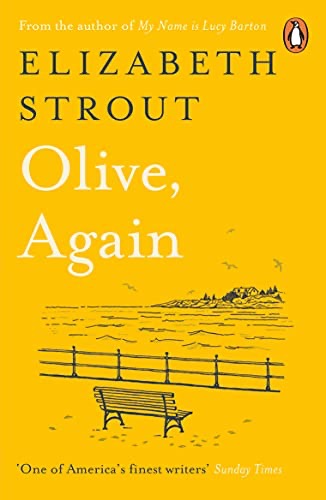
I am currently reading Olive, Again by Elizabeth Strout, the 2019 sequel to her 2009 Pulitzer Prize winning novel Olive Kitteridge. The writer only came to my attention when another of her books, Oh William! made the shortlist for The Booker Prize 2022. I have to confess that this novel was actually one of my least favourite to make the final selection. However, working on the principle that anything I don’t enjoy reading, my partner, Dean, probably will (and vice versa), he embarked upon Olive Kitteridge and loved it so much that I was piqued into giving Strout a second chance and thence became as much a fan as him, Oh William! notwithstanding.
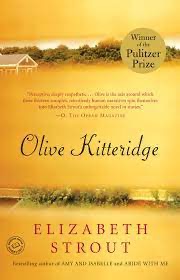
Olive Kitteridge is structured as thirteen stories featuring, but not always starring, the eponymous character and other residents of the Maine coastal town of Crosby. The stories are interconnected but also stand alone in terms of narrative and plot, though when read as a collection, a broader story about the characters and their locale inevitably builds. When asked here by Radio 4’s ‘Bookclub’ presenter, James Naughtie, to clarify whether Olive Kitteridge was a novel or a collection of short stories, Elizabeth Strout responded, ‘I think of it as a book. I don’t think of it as a novel or a book of short stories’. O: The Oprah Magazine put it well when it said that ‘Olive is the axis around which these thirteen complex, relentlessly human narratives spin themselves into Elizabeth Stout’s unforgettable novel in stories’. A ‘novel in stories’ seems to me a very good way to describe it.
The title character is quite an extraordinary creation. A retired junior high school mathematics teacher, you are never quite sure if she would have liked the children she taught or not. Or whether they would have enjoyed being in her class. Regardless, she remembers many of her former pupils she meets in adulthood, often not unkindly and, mostly, they her.
Olive is also described as physically imposing, mannishly tall and over-proportioned: a Frankenstein’s monster of inappropriate parts. Her personality is even more striking. She is at both abrasive and compassionate; bewildered by the changing world around her and at once understanding and uncomprehending of the ways other people navigate their lives in it. She doesn’t suffer fools but can be movingly empathetic. She is thrillingly (and hilariously) wicked sometimes: either when she is not filtering what says among the people around her or, even more shockingly, when the reader is invited inside her head to a private audience of her uncensored thoughts and feelings. I picture a Bea Arthur in ‘The Golden Girls’ but with double the flesh, twice the prickliness and half the tact.
In Olive Kitteridge alone, there is a cast of about 100 characters and a dozen families which it must have required an extensive mind map for Strout to hold in front of her let alone weave together across a mere 288 pages. Yet somehow, the narratives never seem overcrowded and the reader never gets lost among the throng.
In this and all her other works, Elizabeth Strout employs a disarmingly conversational and understated narrative voice which ranges between the present and the past – and occasionally the future – to tell the stories of everyday New Englanders. This style is capable of embracing tragedy without a hint of sensationalism or mawkishness as well as conveying tenderness and the depth of human kindness without sentimentalism or emotional self-indulgence. The result is that the reader is often brought to the brink of speechless tears while the characters stay dry-eyed.

Oh William! is currently the penultimate novel in a ‘cycle’ of four, following My Name is Lucy Barton and Anything is Possible, and coming before Lucy by the Sea, which all tell the current and backstory of the title character, Lucy Barton, a successful New York-based writer who has never quite shaken off the effects of her dysfunctional upbringing in the small Illinois town of Amgash. In the final novel, Lucy and her husband find themselves in pandemic quarantine in none other than Crosby, Maine, the home town of Olive Kitteridge.
Writing for The Booker Prize website, writer, critic, broadcaster and stand-up comedian, Viv Groskop, concludes of the author and her work:
The unifying force in the story cycle? It’s not Lucy or Olive, of course. It’s Strout’s unique way of seeing the world. She zooms in and out like a master cinematographer, examining lives, characters, locations, memories and connections, as if turning over a snow globe and studying it from every possible angle and then shaking it again to start afresh. The effect is unsettling, eerily realistic and strangely close to non-fiction. As the novelist Ann Patchett has written of Strout’s work: ‘I believed in the voice so completely I forgot I was reading a story.’
As anyone studying an Open University course on creative nonfiction might say: tell us about it.
I, for one, am overwhelmingly glad that Elizabeth Stout does.
 Robert James-Robbins