

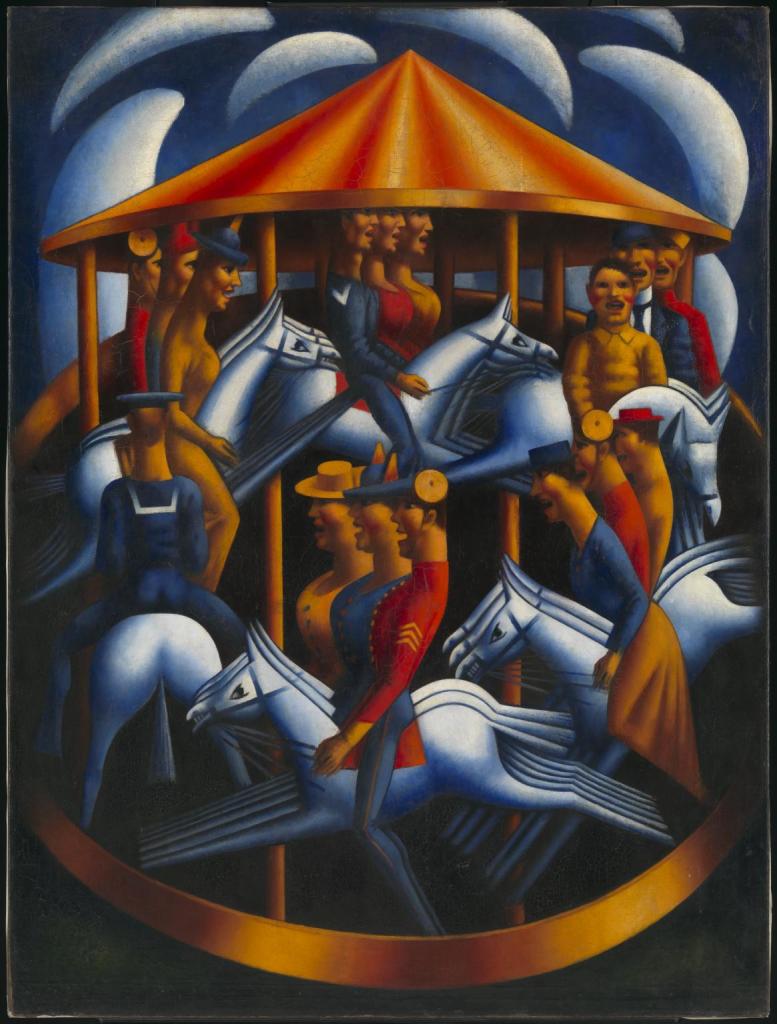
One of my favourite paintings, which hangs in the Tate Britain gallery, is Mark Gertler’s Merry-Go-Round. I first encountered it as a postcard on the bedroom wall of the student housemate who, soon after I moved in, was to become my life-partner for over thirty-five years (and counting). The image and colours instantly brought to mind an illustration on the cover of a book my mother used to read to me when I was very young. In my imagination, the memory of a brightly coloured carousel in a favourite book, and Gertler’s painting, are one and the same. The mind plays tricks, however, especially over such a stretch of time, and I know that it is very unlikely that a publisher would use a painting depicting the nightmarish horrors of war to illustrate a book for young children.
During my Masters in Creative Writing, the initial exhibition of Gertler’s masterpiece in 1917 was the inspiration for a short story I wrote for one of my formal assessments. My preparatory work included reading a collection of Gertler’s letters, an absorbing (and, to date, definitive) biography by Sarah MacDougall, and a 1916 novel loosely based on the artist’s early life: Mendel, A Story of Youth, by Gilbert Cannon.
The son of Polish immigrants born in Spitalfields in the East End of London in 1891, Gertler showed early signs of talent as an artist. After leaving school, he attended evening art classes where his success in a national art competition led to him to winning a scholarship from the Jewish Education Aid Society and, aged seventeen, enrolment at the Slate School of Art. There he became the contemporary of others, such as Paul Nash and Stanley Spencer, who would find fame as British artists.
In 1914, Edward Marsh, an art collector whose civil service day job was private secretary to Winston Churchill, became Gertler’s first patron. Their relationship was an uneasy one. Gertler resented the obligations of patronage, and, as the war progressed, his pacifism and conscientious objection to the conflict clashed with Marsh’s duties in the Government and his relationship with the First Lord of the Admiralty. The two broke company as Gertler completed his most famous, and anti-war, creation, Merry-Go–Round.
The painting was possibly inspired by the annual fair on Hampstead Heath, near which Gertler lived at the time. Writing to a friend about such a fair in 1915, D.H. Lawrence commented, ‘There is a fair on behalf of the wounded soldiers today, and myriads of the wounded, in their bright blue uniforms and red scarves, and bands, and swing boats, and a whole rowdy enjoyment. It is queer.’ Seemingly, Gertler may have witnessed the same scene and also thought it ‘queer’ or, if it was indeed the catalyst for his unforgettable picture, grotesquely obscene in light of what was happening on the other side of the Channel.
Having thrown over Marsh, Gertler found a more conducive and sympathetic patron – and, as it turned out, lifelong friend – in the barrister and collector, Montague ‘Monty’ Shearman. In her biography, Sarah MacDougall describes Monty as ‘broad-minded, tolerant, learned and extremely generous’. He clearly also adored the artist as much as his art: ‘Shearman found himself constantly dreaming of Gertler’s pictures, though he found it “almost impossible” in the artist’s presence to explain how deeply they thrilled him.’
If Shearman’s feelings for Gertler went beyond the purely professional and platonic, they remained unspoken and unrequited – and tactfully unnoticed by the artist himself. However, coming across a mesmerising self-portrait of the artist as I was reading Sarah MacDougall’s book, I was prompted to write this short piece based on an incident she describes in the early days of Gertler’s association with Shearman:
The Self-Portrait
In the end, the Artist is left standing with his neck framed by the distorted rim of a Roger Fry tray, violently smashed over his head by his friend, leaving it poking through like an obscene three dimensional, and breathing, surrealist self-portrait.
Gertler does not even have the excuse of inebriation to explain why he and his Russian friend, Koteliansky (‘Kot’), who has drunk enough for both of them, go berserk and trash the London pied a terre of the artist’s patron around the time the First World War was coming to an end in Europe. They do not even have to break in; they just let themselves in using the key which has been entrusted to Gertler by his kind, generous and slightly besotted friend, Montague ‘Monty’ Shearman.
Shearman’s rooms in the Adelphi Hotel had been set up for a sophisticated soiree (no common or garden ‘do’ supplies its guests with eau de cologne, after all) and were awaiting the return of the patron including, very likely, the legendary Diaghilev and half his dance company following that night’s performance at the Coliseum. In tow to the two hooligans, fellow artist, Beatrice Campbell, and her husband, Charles, are powerlessly horrified at the vandalism taking place before their eyes: the grotesque gorging and swigging of food and drink, the scattering of flowers and soft furnishings, and, over the furniture as they leap about it, the manic spattering of the eau de cologne. The vandals, hysterical with laughter and euphoria at their anarchy, abandon the scene before the ballet party arrives.
No record exists of Shearman’s reaction to the discovery of this destruction, but the identity of the perpetrators is soon known to him. Remarkably, this barrister-cum-art collector takes no action beyond asking for the return of the key, and never mentions it again to Gertler, nor breaks off his patronage or friendship.
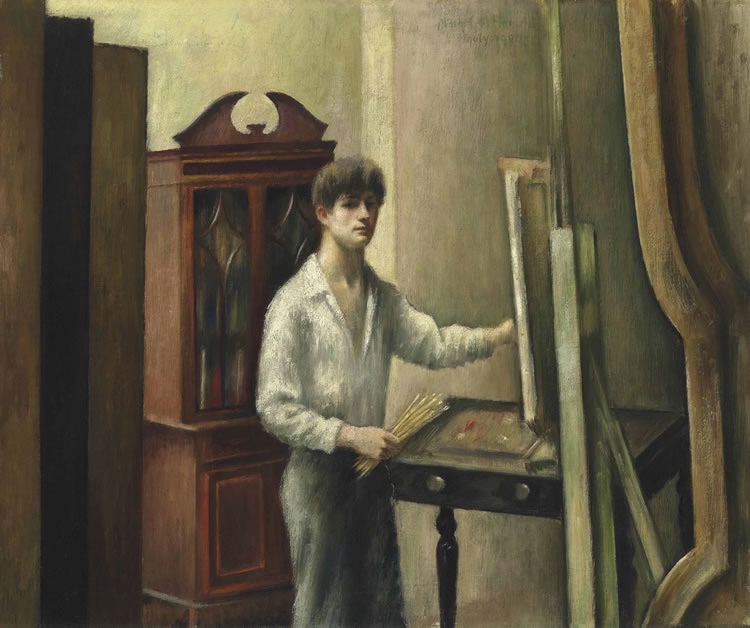
Photographs and, more vividly, self-portraits of Gertler give us the strongest explanation for Shearman’s turning a blind eye to such an outrage – although the generally accepted belief that the drunken Kot bore more guilt as the instigator of the onslaught helped to mitigate his accomplice’s culpability. Mark Gertler, the East End prodigy of a poor, Jewish immigrant family, always had great sex appeal for men and women. His self-portraits – and his famous egotism – suggest that he was not only very aware of this but that he was not a little in love with himself as well.
One portrait, executed in 1920, a couple of years after this incident, is undeniably captivating. He stands, almost full length, his right side forward, painting in his studio. His slight figure is draped in a white shirt, its sharp collars contrasting the soft fabric which barely seems to touch his skin; indeed, it is open-necked and unbuttoned recklessly to reveal a Byronically indecent view of taut and mildly hirsute chest. Dark trousers becomingly draw attention to slim waist and shapely buttocks. The eyes, looking directly at the viewer rather than the easel in front of the figure, are more like shadows, dark and deep set; the thickness of the eyebrows match the enviable bushiness of his hair, which tapers at his temple to an irresistible vanishing point on the pale, high cheek bone. At right angles to his mouth, a crease forms part of the top line of a rotated ‘T’, the soft lips playing the reclining stem of the letter, the whole a languorous character hovering above the chin, possibly dimpled, but certainly rounded in an inviting pout.
No wonder Monty Shearman, who fastidiously only looked and never touched, was prepared to brush his friend’s indiscretion under the thick carpets of the Adelphi in November 1918.
This is an updated version of a post from 2023. The fictional account of Gertler running amok in Shearman’s apartment remains unchanged.
 Robert James-Robbins