

This piece of creative nonfiction was featured in the inaugural issue of the Liennek Journal in July 2022. I was reminded of it yesterday when I took my sister and her family (visiting from Australia) to the Padstow Christmas Festival and we ended the day with a walk to view the Camel Estuary as it stretches out to sea.
The Padstow Mermaid was shot for love by a local man. Accounts differ on the details. He did it either out of wounded pride when she refused to reciprocate his love or as an act of desperate self-defence when she, having fallen head over tail for him, tried to drag him beneath the waves. Her revenge is the Doom Bar sandbank between Hawker’s Cove and Trebetherick. How she formed this perilous submerged ridge is, again, a point of debate. In one version of events, she flung a handful of sand into the water. In another, she cursed the harbour and raised a tempest. Whatever the truth, this sand hazard has proved tricky for centuries-worth of craft to navigate: the waters between Padstow and the open sea are deceptively tranquil. The Doom Bar’s litany of destruction, recorded since 1800, numbers over six hundred. It is a heavy albatross around the neck of the little fishing town.
Padstow has thousands of visitors but remarkably few venture beyond the town’s bustling commercial centre. Fewer get beyond the war memorial at St Saviour’s Point, a steepish walk only minutes around the corner. But those that do cannot fail to appreciate the extraordinary view of the Camel Estuary that opens up around them as they climb the hill. To the right: the River Camel, starting its slow thirty-mile meander upstream. To the left: those deceptively tranquil waters, flanked between miles of golden sand and, further along, the south and north headlands Stepper and Pentire.
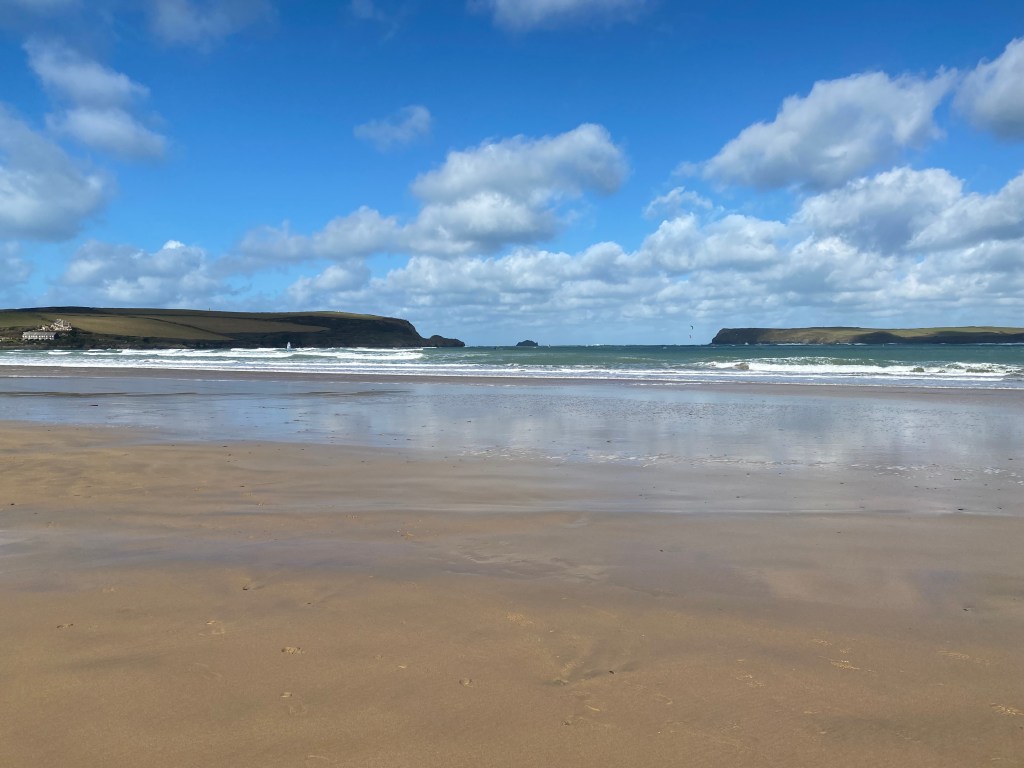
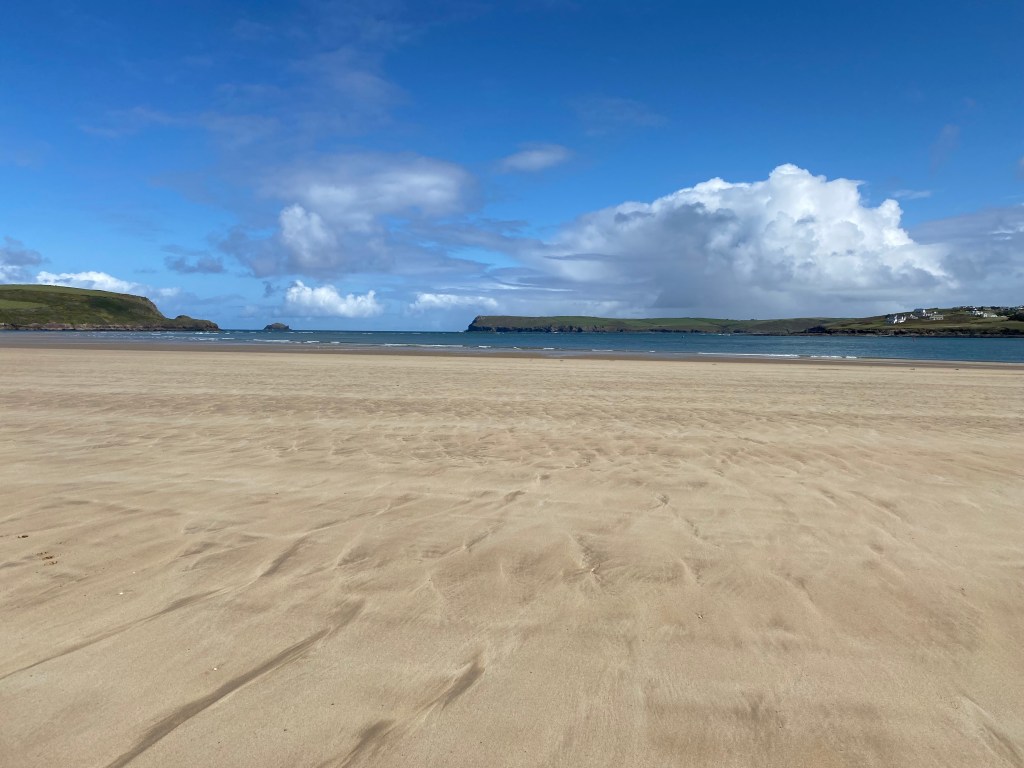
Those who walk further are richly rewarded for their perseverance when they come to Harbour Cove. Here is nearly two miles of the most pristine sand backed by picture-perfect dunes, which can be viewed either from the coastal path or the shoreline. The vista of the estuary mouth makes you catch your breath in its sweep and simplicity. The narrowing headlands, with Puffin Island caught between the two, draw your eye to the point where sea meets ocean.
Due to the seabed’s shallow incline, the scene changes constantly with the tide. When the tide is high, Harbour and Hawker coves are cut off from one another, the only land access the coastal path cut through to the dunes. When the tide is low, you have to fight the illusion that you can wade across to Rock, Polzeath, and Trebetherick: a deep channel keeps the two sides apart, a natural and symbolic divide. Those doppelgängersands may be more popular (not least with ex-Prime Ministers), but those on the Padstow side are never crowded, even in the height of summer.
I owe my appreciation and enjoyment of this Cornish idyll to Rick Stein, at whose Seafood Restaurant we celebrated my thirtieth birthday in July 1997. Just two years earlier, his first BBC television series not only tickled our foodie tastebuds but kick-started the Stein Phenomenon, which has divided opinion in Padstow—if not the whole of Cornwall—ever since.
On the day itself, we deliberately allowed the high tide to maroon us on the rocks between the coves. In the hours before and after the sea’s ebb and flow, we had the beach almost entirely to ourselves. The weather, though overcast, was warm and we thought nothing of the invisible ultraviolet rays bearing down on our faces—at least, not until looking at the photos of us posing outside the restaurant that evening, our shining noses captured for posterity in Falstaffian embarrassment before a drop had passed our lips.
Our sunburned skin peeled, healed, and was forgotten quickly, but my love for the estuary grew exponentially. Happy memories of subsequent visits abound—as a couple, a family (nuclear and extended), with friends and, sublimely, on my own, sitting on the white sand with my back to the dunes and the sea glimpsed above the rim of my novel. One moment, however, endures and dominates, filling me with emotion for both place and person. Applause! Clapping! Whistling! Whooping! An audience of beautiful, lounging twenty-somethings, years away from the responsibilities of parenthood, rise to their feet in admiration as our five-year-old son cartwheels along the beach, over and over, again and again, for yards without pause. It’s as if he’s picked up on the salty air the irresistible song of the Padstow siren, and she’s luring him to his doom among the waves like a sea-based pied piper. Except, no. Not this chip off the block. He is behaving as if he has the world pirouetting at his head as well as his feet, his destiny fearlessly gripped in both of his own hands.
 Robert James-Robbins