
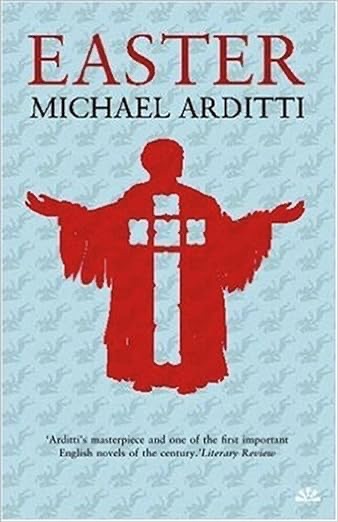
‘Easter’ (2000) by Michael Arditti
‘Easter Wings’ by George Herbert (born April 3 1593; died March 1 1633)
Last week, I gave myself a break from working through a re-read of Alan Hollinghurst’s oeuvre of six novels. The Swimming-Pool Library; The Folding Star; The Spell; The Line of Beauty: all done. Thirty percent on-going on my Kindle, The Stranger’s Child; after that, finally, The Sparsholt Affair, currently the baby of the bunch, at least until the publication in the autumn of Our Evenings, Hollinghurst’s seventh novel, and his first publication in seven years.
For my brief change of scene, I chose Michael Arditti’s Easter. Though having absolutely no religious belief whatsoever, the structure of the novel appealed to my love of a good organising principle as well as to a geographical setting I know very well. And as a devotee of the works of Barbara Pym, the subject matter seemed right up my street too.
Each chapter uses as its focus a liturgical landmark of the Christian church’s Holy Week, from Palm Sunday through to Easter Day as marked by a fictional Anglican community in Hampstead, North London. However, it wasn’t until I came to the chapter set on the night of the Saturday vigil before Easter itself, and yet barely a third way through the book, that I re-checked the Contents page and realized that Arditti had really gone to town, giving his reader symmetrically satisfying structural double helpings.
The first part describes the dramatic events of the week leading up to Easter through the eyes of one set of characters, some of the parishioners and clergy of the parish of St Mary-in-the-Vale. Then, after a long chapter-less middle section narrated entirely from the point of view of the novel’s central protagonist, a third section takes us back to the start of the same week but this time with each religious occasion seen from the perspective of another set of characters with varying degrees of interest and involvement in the NW3 church. This final part both illuminates and forces the reader to review what he thinks has gone before, with new events, back stories and character unfoldings which surprise as much as they fill in crucial blanks, bringing the denouement to a pleasing sense and conclusion.
As the critic, Peter Stanford puts it:
With its three sections and cast of thousands mirroring the time-honoured triptych, [the novel] delivers a technically impressive, emotionally moving and deeply disturbing chronicle of death and resurrection.
To avoid giving away its gripping story – the other reason, beyond its satisfying structure, that I enjoyed Easter so much – I defer to the words of other admirers to give a flavour of what you might enjoy in the novel as well:
It’s a delight to find a modern novel that takes religion and all the objections to it seriously as a subject: the rockpool of a London parish teems with all kinds of curious life – Philip Pullman
As in his excellent earlier novels, ‘The Celibate’ and ‘Pagan and her Parents’, Michael Arditti is deliberately provocative: he reads at times like the unlikely love child of Derek Jarman and Barbara Pym, presenting a story of parish backbiting against a bleak backdrop of lust, corruption and disease. But this is a novel of such moral seriousness that, before long, one reaches for grander models. In the scale of its aspirations and the savagery of its satire, ‘Easter’ reminds me of Charles Dickens. I think it is Arditti’s masterpiece – Damien Thompson, ‘Literary Review’.
The author handles his material with considerable skill. Few other contemporary British writers of fiction are prepared to become immersed in metaphysical territory. Arditti’s dialogue and imagery are memorable, and his eye for the quirks of Anglo-Catholicism recalls Barbara Pym at her best. His depiction of strong emotions – especially suffering – proceeds from deep feeling and is always honest -‘Daily Telegraph’
That final comment’s mention of the metaphysical, and the fact of my reading Arditti’s novel at this eponymous time of year, brought me back to a brilliant analysis of George Herbert’s poem Easter Wings, which I have cherished for over thirty years since it appeared in ‘The Guardian’ on April 3 1993, the 400th anniversary of the writer’s birth. Herbert was one of the metaphysical poets and their works which I studied with my wonderful A Level English teacher, Jane Seabourne, herself a writer and accomplished poet, back in the 1980s.
For my part, I have rarely read a more succinctly convincing, erudite, clear and well-researched piece of literary analysis. The points about line and syllable number, and other structural and organisational matters, are delicious food and drink to geeks of close textual analysis like me. And one of the reasons I am such a nerd about such things owes much to Jane’s inspirational teaching forty years ago.
The original article does not seem to be available on the internet despite my best search efforts. I hope readers of this can zoom in to read – and enjoy as much as me – this photograph of my original copy of the article:

Postscript
The title of this post was inspired partly by something said by one of the characters in ‘Easter’ and partly by the fact that I first encountered the phrase in the comment on my very first essay when I was a sixteen-year-old A Level student. Written, like all Jane’s feedback, in a brightly coloured ink – NEVER red – the stylish, expressive script always seemed to convey its hand’s warmth, encouragement and love of subject, even if, on this inaugural occasion, I had to ask the marker what it meant.
In its original appearance (in the magazine ‘Punch’ in 1895) the meaning of the phrase ‘curate’s egg’ was that of something obviously bad but attributed redeeming features for the sake of politeness. For many years now, its meaning has subtly but crucially changed (thankfully for my A Level essay if nothing else) to mean something with both good and less good parts.

For me, and for Michael Arditti it seems, the phrase epitomises what it is to be human, and imperfect, conveying an understanding that all of us, however accomplished, always has something to learn and improve. To this day, the phrase also evokes very happy and grateful memories of my English lessons, and my incomparable teacher.
 Robert James-Robbins
2 responses to “Curate’s Eggs”
Thanks for that, I could zoom in. I’ve not read any Barbara Pym, you’ll have to recommend me a title to begin with, and I’ll put this Arditti on my list too.
LikeLike
Start with ‘Quartet in Autumn’. She nearly won the Booker with that. Then ‘Crampton Hodnet’, ‘Jane and Prudence, then ‘Excellent Women’.
LikeLiked by 1 person