
By Jane Seabourne
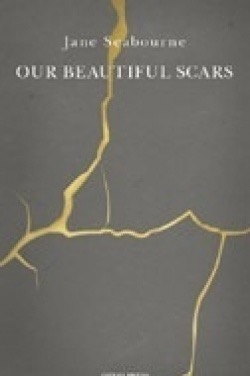
I have just read ‘Our Beautiful Scars’ (2017), the second collection of poetry by Jane Seabourne. As well as being a writer, editor and mentor, Jane is a teacher – and, significantly for me, my former A Level English teacher at Pontypool College in the 1980s. We haven’t met in person for nearly forty years but, having re-established contact more recently, we are now in email communication several times a year. Having followed Jane’s footsteps into a career as an English teacher myself for nearly thirty years, today her Pied Piper personality (charismatic not sophistical), as well as her writing, inspire me as I try my hand at creative writing in my teaching afterlife.
Many of the poems in the collection reflect Jane’s experience growing up, like me, in the Eastern Gwent valley of the Afon L[l]wyd, the fast-moving north-south river sourced in the former mining town of Blaenavon which thirteen miles later flows into the River Usk at the former Roman settlement of Caerleon. In between, the short, sharp, shock of its waters speeds by the villages and towns of Abersychan, Pontnewynydd, Pontypool, Llanfrechfa and Cwmbran.
In the opening poem, ‘Sheep’, the speaker tries to describe to a child where she grew up, a place through which ‘a grey river/ front-crawled its way to the sea’. That down-to-earth verbal phrase is typical of Jane’s style which, as one reviewer says, has an ‘economy and directness of language, and accessibility’ which is not ‘flamboyant or showy’ but which shows a ‘quiet precision of language and observation’ (George 2017).
Jane and I were educated at different times at the respective girls’ and boys’ grammar schools in Pontypool – ‘Ponty’ as she colloquially styles the town in the poems. The schools stood on opposite sides of the valley, the distance, river and town planners keeping their respective pupils (the heterosexual ones, at least) more than a deterring arm’s length apart. The importance of education and educators, and of becoming teachers ourselves, are themes to which Jane returns more than once in this collection: the experiences and people that leave impressions – some of them ambivalent, perhaps, like the oxymoronic beautiful scars of the book’s title – on our memories and psyche.
The influence of women, especially female teachers, in the poems resonates particularly strongly with me. At Jane’s time at ‘The County’ most if not all of the predominantly female staff would have been single, marriage forcing women to resign their employment and leave the profession even up to the progressive 1960s. By the late 1970s, at ‘West Mon’, my boys’ only alma mater, female staff were in a minority, but at least by then allowed to have husbands without losing their jobs.
In ‘Miss Buss and Miss Beale’, an anonymous satirical rhyme about the two famous nineteenth century pioneers of women’s education, Frances Buss and Dorothea Beale, serves as epigraph to the poem’s reminiscence about the speaker’s own teachers, all of them titled with a spinsterly ‘Miss’.

Cupid‘s darts do not feel.
How different from us,
Miss Beale and Miss Buss.
The opening stanza is a tongue-in-cheek smile at the romanticized way these teachers were talked about by their pupils, generations of the latter relaying a made-up history like the best, adoring but gossipy, Brodie sets:
Their fiancés were blown up in The War
a story passed down to new bods
when we first started at the county school for girls –
and though they nearly died from grief
our teachers devoted their best years to teaching us –
A series of appreciative memories of these selfless professionals culminates in the speaker’s praise for one of her English mistresses. Teaching her charges the superiority of fiction over reality is the resplendently named, Miss Aurella Jones
who showed us that Richard Hannay or Sexton Blake
would turn out in the end more lasting
than something as easily combustible as a man.
Miss Aurella (known thus familiarly among the girls – though obviously not to her face – to distinguish her from all the other inevitable Miss Joneses in the Welsh valley institution) was a muse to the schoolgirl, Jane. In her turn, my teacher (radically – and thrillingly – ‘Jane’ rather than ‘Miss Seabourne’) was an inspiration to me, not least for introducing me to a view of the world seen though a progressive, feminist, and mildly satirical and humorously irreverent prism which, while not changing my politics at the time, did give me the values that would underpin so much of my reading, analysis and teaching of English literature in the future. And much of my life in general.
In ‘Enter the Teacher’, facing her first class of the academic year in a room of thirty-four what we would now call ‘Year 11’ boys (aged fifteen or sixteen), a newly-qualified teacher feels a sense of imprisonment and vulnerability that mirrored my own feelings among a class of similarly aged pupils at Woolwich Polytechnic School for Boys in the final term of my PGCE year over thirty years ago. The poem’s speaker notes, grimly, that,
one has Doris Day written on his ruler
the other thirty-three – she will discover –
believe books are for snobs, poofs or women.
Reading the poem today, I cannot help but feel closely aligned to the Doris Day boy and the other bookish stereotypes, but bristle at the speaker’s acute awareness of her unwelcome presence (and isolation) in the male-dominated boys’ school, barely hidden by a Head of Department:
who wanted his junior English teacher
to shave twice a day and know the off-side rule
Her sense of solitary confinement is confirmed towards the end when she finds herself, a copy of ‘Stig of the Dump’, and a packet of Benson and Hedges, hiding (or is it escaping?) in the only female toilet at the back of the cleaners’ ‘mop and bucket room’.
There are more laughs in the poem ‘…33, 34, 35…’ which satirizes the idealistic aims of the ubiquitous school trip through a teacher’s lasting memories of the more prosaic reality:
We have organised cultural outings on Mondays –
the universal closing day for museums
deprived teenagers of slot machines at Service Stations
disappointing them with Rembrandts and Picassos
But the ‘scars’, again, are mixed. While the teachers have ‘bailed students from foreign police stations, / armed only with O level French’ they have also,
dried tears; mended broken hearts;
cured homesickness with doughnuts;
deployed sick bags at the exact moment of need.
And some of the scars are very beautiful indeed, cutting deep, invoking tears, though not of pain:
We have watched as landlocked kids
Saw the sea for the first time and rejoiced.
In ‘…and goats’, Jane celebrates eccentricity, and the broadening of horizons, epitomized by the goats’ milk brought to work by the new head librarian which, as well as galvanizing the tea, is a catalyst for other revolutions: taking the lid off the loaning of eighteenth-century so-called ‘erotica’ (such as ‘Fanny Hill’ – was it the content or merely the title that gave the original offence?), and the ripping up of the ‘No Talking’ signs. And, possibly most shockingly of all, by the enjoyment of ‘half and half’ with a curry at the new Indian in the flesh pots of ‘Ponty’: not a euphemism for a three-way orgy (not in Pontypool, please!) but the signature south Wales double carb accompaniment of rice AND chips.
In ‘A: A Long Weekend’, Jane takes her most vicious satirical swipe at the insistence that teachers of many years’ experience and in all disciplines prove that they can do sums in order to continue to do what they had been doing successfully for years. The speaker recalls the hours spent at her father’s knee, practising quadratic fiddle-dee-dee and other nonsense, finally to get her Mathematics O Level, the certificate for which she will eventually dig out to prove to a faceless bureaucrat that this highly competent – nay, brilliant – teacher of English Literature need not sit ‘Numeracy, level 2’ (FFS!) to continue her extraordinary magic with minds and words. For me, it recalls the excruciating tear-filled torture of my father pummelling into me the mysteries of long division which, aged nine, he insisted my school ought to have taught me by now. And in a cruel instance of déjà-vu, inflicting the same abuse, three years later, to an equally distressed younger sister. She, later, also taught by Jane, though not appreciating the privilege in quite the same way her older brother had.
‘Our Beautiful Scars’ is more than a tribute to female school teachers and the importance of academia. It’s an homage to women who pass on knowledge and learning to their sisters (and a few brothers) of, among many things, the mysteries of the universe; the knitting of mittens worn by the grammar school girls desperate to escape provincialism; the baking of scones according to the tried and tested recipes of mothers, grandmothers, aunts and cousins; the enjoyment of ‘Middlemarch’, ‘Paradise Lost’ and ‘Pride and Prejudice’. I am certainly eternally grateful to the women (mother, aunts, cousins, teachers, colleagues, Jane Seabourne), and a few men, for the beautiful scars they left imprinted deeply in me.
When I got my MA in Creative Writing at the end of 2023, I emailed Jane to thank her for the crucial part she had played all those years ago in my education and in my love of literature, reading and writing. In true Seabourne style, she noted a cascade of inspirational English teaching: Miss Aurella Jones to her, she to me, me to my own students: ‘As they say in The History Boys,’ she wrote, ‘we pass it on.’ She then shared a poem she had only recently written:
Back then, we didn’t know anything about our teachers
i.m. Miss Aurella Jones
and we only knew her name because –
being Wales – there were at least six Miss Joneses
on the staff and she was Miss Aurella.
You would check your lessons for the day,
see double English and think fab.
She wasn’t one of the sarcastic ones,
She wasn’t tweedy. She was old, of course,
but she had gold hair. She wore lipstick
and there was something bardic in her voice
that made you want to sit in the front row
nearest her desk. Miss Aurella Jones.
If Jones pinned her to the map and the Miss
put her in her place, Aurella elevated her,
gave her power to put all sorts of spells
on girls like us.
November 2023
I too remember looking at my timetable in the 1980s, seeing ‘Double English: J. Seabourne’ and thinking, ‘Fab. Just fucking fab.’
 Robert James-Robbins
2 responses to “‘Our Beautiful Scars’”
How lovely that you’re still in contact with your English teacher. We had a couple of good ones. I remember a Miss Hopper who was as short as most of the kids but could still command the room.
Also I think ‘half chips, half rice’ is also a bit of a Liverpool thing.
LikeLiked by 2 people
Just read this in the British Library Reading Room, fabulous.
LikeLiked by 2 people