

In the opening paragraph to his LRB review of Gareth Greenwell’s Cleanness (2020), Edmund Gordon, lecturer in Creative Writing at King’s College London (my alma mater, as it happens) writes:
In U&I (1991), his book about John Updike, Nicholson Baker imagines explaining the appeal of Alan Hollinghurst’s ‘The Swimming-Pool Library’ to his literary hero. ‘You know, once you get used to the initially kind of disgusting level of homosexual sex, which quickly becomes really interesting as a kind of ethnography, you realise that this is really one of the best first novels to come along in years and years!’ But Updike couldn’t get used to the sex. Reviewing Hollinghurst’s third novel, ‘The Spell’, in 1999, he complained that ‘our noses are rubbed, as it were, in the poetry of a love object’s anus’ and about the author’s habit of recording ‘penile sizes, tilts, tints and flavours … with a botanical precision’. Never mind that Updike’s own work displayed a comparable attentiveness to the shapes and shades, tensions and textures of female genitalia; that was an altogether more meaningful business. ‘Novels about heterosexual partnering … do involve the perpetuation of the species.’ How this was involved in the oral sex in Couples (1968) or the anal sex in Rabbit Is Rich (1982) wasn’t explained.
When I came across this tongue in cheek swipe at the homophobia of Baker’s biographical subject (and Gordon’s own more explicit hit on Updike’s bigotry and hypocrisy – though resisting the temptation to play puns with his surname, as I have done in my head) it seemed a fitting way to begin this retrospective of the novels of Alan Hollinghurst which I began at the start of the year when I saw that the Booker Prize-winning writer’s seventh novel was due for publication in the autumn.
So it was that, a week ago, I finished reading The Sparsholt Affair (2017), the last and most recent novel in Alan Hollinghurst’s oevre of six. I have been a fan of the writer’s work for many years. Hollinghurst is arguably the UK’s most accomplished living fiction writer and certainly its best living gay novelist. ‘Gay’, not just in the author’s own identity but also in his bold writing of content, characters and stories which reflect the world in which I live but do not always see in much of the heteronormative worlds I read. Gordon’s review of Greenwell’s novel continues in a vein with which I have much empathy:
Garth Greenwell was born in 1978 and first read The Swimming-Pool Library when he was twenty (around the time Updike was reviewing The Spell). He described the ‘immense sense of permission’ it gave him: ‘There was a great liberating thrill in reading … a book that was so unapologetic in its representation of men having sex – pleasurably, promiscuously – with other men. It felt radical in its indifference to the moral judgments of straight people.’
This is not a review of the novels. That would take far too long and has been done many times already, in other places, and by better critics than me as any online search in the archives of major British and US newspapers, and literary journals such as the London Review of Books, would testify. However, I am going a bit ‘Top of the Pops’ with a very lowbrow ‘hit parade’ of my second reading the novels, some now ‘charting’ higher, lower or just the same since I first encountered them.
Number Six: The Spell (1998)
No change. Hollinghurst’s third novel has always been his weakest in my opinion and it remains so, even after an admittedly more favourable reading second time round.
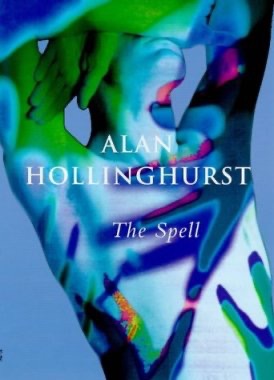
My memory of the novel as a thirty-one year old (and why it grated somewhat) was that it was strewn with too many middle-aged men getting off their faces on the latest designer drugs (and getting off with lovers young enough to be their sons) in an endlessly unrealistically world of hedonism and narcissism which left me yawning for a break rather than panting to join in; a world I had briefly flirted with in my twenties and long abandoned for a (mostly) sober life of monogamous domesticity.
My re-reading was far more enjoyable than I had expected and I found that my memory had not serve me well. Yes, there are nightclubs, and drugs and unlikely sexual pairings but they do not predominate as I thought they did; I could also now appreciate their presence – and the point – more than I did in my priggish thirties. My criticism this time round, and why the novel remains at numero six, is that it is too short and underdeveloped; that there are two main characters (Robin and his younger ex, Alex) about whom the novel never makes up its mind is the more important or interesting, or into whose consciences and experiences to take the reader more deeply. I was left wanting to know more about both and/or wanting the novel to decide which was the main man.
The latter itself is has been a bit of an issue for Hollinghurst, of course. The Spell has few women characters, and none that is fully developed, a criticism often levelled at Holloinghurst’s early novels. After this, his third, the charge had clearly gone beyond a niggle and in the next three books he undoubtedly tries harder with the ladies.
With The Spell, I also wondered whether Hollinghurst felt under pressure to produce something more quickly for his publishers after his second hit, The Folding Star, four years earlier, had taken six years to succeed his debut triumph, The Swimming-Pool Library. We have all now become accustomed to Hollinghurst taking his time, but this was still in his pre-Booker winning days, when he probably still felt he had to dance more promptly to his publishers’ tune.
Number Five: The Sparsholt Affair (2017)

I loved it when I first read it in 2017 and, at the time, it would probably have been in my top three. I remember not being able to put it down. But that was the trouble, I now realize after my return visit. Following an outstanding opening section, and intriguing second, I couldn’t wait to read the remaining three parts, the whole quintet spanning the novel over some seventy years or more. What I’d not appreciated first time round was that this urge to read on and to find out more is ultimately frustrated, leaving the reader unsatisfied and with a feeling of, well, meh. The ongoing lives of the main protagonists, introduced as undergraduates doing their bit for King and country in the early 1940s, scouring the Oxford skies from College roofs for German bombers in between formulating intriguing relationships among themselves, are only ever obliquely fleshed out in the subsequent sections. In fact, it often feels as though they have been deliberately hidden or avoided in an authorial game that goes too far, is too clever by half, and which ultimately irritates rather than entertains.
The main characters of that wonderful first section – David Sparsholt, Freddie Green, Evert Dax, Jill Darrow, Peter Coyle – are never bettered by their reappearances later on, or by those who replace them, not even the book’s main protagonist, Johnny Sparsholt, who remains underdeveloped after a promising introduction in part two. This is a novel of omission and I cannot disagree with the conclusion of critic Adam Mars Jones (2017) who bemoans the opportunities lost or deliberately avoided in the sidelining of potentially bigger stories (such as the eponymous ‘affair’, at the centre of which is the magnetically enigmatic David Sparsholt, father of Johnny) in favour of the less dramatic tales we are left with:
By the end of ‘The Sparsholt Affair’…the book contains all the elements required for a generational saga, though it fastidiously abstains from assembling them. There’s no sense of a symphonic development either. Plot climaxes, if they come at all, are displaced onto minor characters…Dramatic events take place in the gaps between sections…The book has turned its back on the road it seemed to mark out for itself, and readers are shielded from vulgar drama. But if everything important is relegated to the peripheries or takes place in the gaps between sections, what’s in the centre? Is there really no need for one?
Numbers Four and Three. Or Joint Third.
In the middle, I place The Line of Beauty (2004) and The Stranger’s Child (2011). I can’t decide which way round.

The former, Hollinghurst’s great satirical swipe at the politics and hypocrisies of the 1980s (including an unforgettable appearance of a dancing Prime Minister, Margaret Thatcher) won him the Booker Prize. The latter, a tale of a Great War poet (loosely based on Rupert Brooke) whose life and legacy reverberates down the decades, didn’t even make the shortlist, if these things matter. I definitely expected to continue to prefer The Line of Beauty. I was surprised, therefore, to find myself not as bowled over by it as my memory (and its critical acclaim) suggested I would. In contrast, I was delighted to discover how much I enjoyed my reacquaintance with The Stranger’s Child.
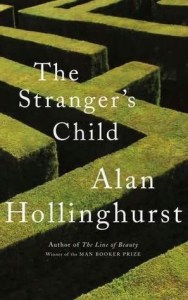
This could simply be explained by context and environment: I read the latter the first time round over the course of two 12-hour flights between London and Kuala Lumpur; the book in hardback; me in economy, and at the mercy of my eight-year-old son’s need for periodic attention and entertainment. Taken together, these were hardly the most conducive circumstances in which to read a book of five hundred and seventy-six pages.
Re-reading The Stranger’s Child (this time, sensibly, on a Kindle) was a surprising pleasure. With stories and characters weaving through a century of time, in structure and characterisation, there are hints of Ian McEwan’s Atonement, something else that had worried me. However, the Hollinghurst round two turned out far better than I had remembered, and much better than I remembered the McEwan (though who knows how I would react today to a re-reading of that acclaimed novel?) The story/ stories never wain; the characters sustain interest; and there are more, and more finely drawn, female characters, than in Hollinghurst’s other novels; there’s also less explicit sex. The latter was a matter of indifference to me, though it made a change to experience the tantalising suggestiveness of intimacy rather than the more wham, bam approach of some of the other novels. Both varieties are handled with consummate skill by the writer – and equally enjoyable to read, of course. Which brings me, rather appropriately to the final (climactic?) Top Two.
Number Two: The Folding Star (1994)
This is the story I remember reading avidly on the Tube, strap-handling through evening rush-hour as well as more civilly seated in the early mornings, as I journeyed back and forth under the Thames to get to and from the school where I was teaching English in my first job in the profession.
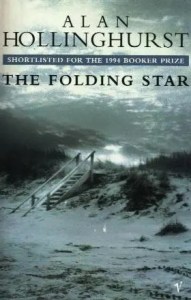
Without giving too much away, it concerns (would you believe?) an English teacher, Edward Manners, who, disaffected with life, moves to a Flanders town to teach two students: Marcel, plodding and plain; Luc, gifted and beautiful. Both, for different reasons, are not attending the school which Manners’s digs overlooks. Through his emerging friendship with Marcel’s father, who curates a museum of paintings by a famous Belgian symbolist, Edward learns about the twilight worlds of both painter and curator, while the reader enters into the vortex of the protagonist’s infatuations and obsessions, past and present.
The New York Times Review of Books commented that
You could read this novel as a miniature ‘Remembrance of Things Past’ or as an expanded ‘Death in Venice’, or as a homosexual ‘Lolita’.
Peter Kemp, writing in the Times Literary Supplement, said
Even in its sexiest moments, it never loses its intellectual poise. Dry witticisms intersperse sweaty couplings…’The Folding Star’ is a novel of considerable breadth. What gives it its depth is the candour, wit, sensuous immediacy and melancholy intelligence applied to it.
I enjoyed my re-read enormously and, because my memory had, again, played tricks with me, I found myself as eager to turn the page as I did in 1994 and was surprised a second time by the revelations and how things turned out.
Number One: Swimming-Pool Library (1988)

The joy of having not read Hollinghurst’s debut novel for over thirty years is that it was genuinely like meeting it for the first time. Set in London in 1983, Will, is a privileged, gay, sexually irresistible (and insatiable) young man who saves the life of an elderly aristocrat, a chance meeting that will lead to a job offer, the uncovering of a fascinating, untold story and a re-evaluation of Will’s family history. The Sunday Times says of the novel that
The tautness and energy of Alan Hollinghurst’s novel derive from its ambiguous status as it shimmers somewhere between pastoral romance and sulphurous confession, between an affectionate and credible rendering of contemporary mores and lurid melodrama…classic English prose…surely the best book about gay life yet written by an English author.
The New York Time Review of Books that The Swimming-Pool Library
Beautifully welds the standard conventions of fiction to a tale of modern transgressions. It tells of impurities with shimmering elegance, of complexities with a camp-fired wit and of truths with a fiction’s solid grace.
As I wrote in an earlier post, I just think this book is a gloriously joyful and equally wonderfully written story about worlds and characters that probably could only exist in the pages of fiction but nevertheless feel so real that you could (and certainly want to) touch them. Wow! A Number One hit indeed.
Our Evenings, Alan Hollinghurst’s seventh novel, is published On October 3 2024.
From the publishers:
Did I have a grievance? Most of us, without looking far, could find something that had harmed us, and oppressed us, and unfairly held us back. I tried not to dwell on it, thought it healthier not to, though I’d lived my short life so far in a chaos of privilege and prejudice.
Dave Win is thirteen years old when he first goes to stay with the Hadlows, the sponsors of his scholarship at a local boarding school where their son Giles is his contemporary. For Dave this weekend, with its games and challenges and surprising encounters, will open up heady new possibilities, even as it exposes him to Giles’s envy and violence. As Our Evenings unfolds over half a century, the two boys’ careers will diverge dramatically, Dave a gifted actor struggling with convention and discrimination, Giles an increasingly powerful and dangerous politician.
Our Evenings is Dave Win’s own account of his life as a schoolboy and student, his first love affairs, in London, and on the road with an experimental theatre company, and of a late-life affair, which transforms his sixties with a new sense of happiness and a perilous security; but it is also, very movingly, the story of his hard-working widowed mother, whose own life takes an unexpected new turn after her son leaves home.
Both dark and luminous, poignant and wickedly funny, Alan Hollinghurst’s new novel gives us a portrait of modern England through the lens of one man’s acutely observed and often unnerving experience. It is a story of race and class, theatre and sexuality, love and the cruel shock of violence, from the finest writer of our age.
 Robert James-Robbins
One response to “Hollinghurst Revisited”
I have only ever read The Swimming Pool library, and that too was around thirty years ago. I’m glad it’s at the top of your list then. I will try and get around to re-reading it
LikeLiked by 1 person